Ethical Tech CoLab · open research programme
Rail noise from the NYC Subway crossing the Manhattan Bridge into DUMBO, Brooklyn — measured by the operator, uncomplainable to the city, and unstudied where people actually are.
This is the short version: what the problem is, artifacts you can hear and navigate for yourself, and what has actually been established. The research holds the evidence underneath it — every document, the open questions, the work still to be done, and the claims this programme has had to withdraw. Both pages are regenerated from the repository, so the counts on them cannot drift away from the work.
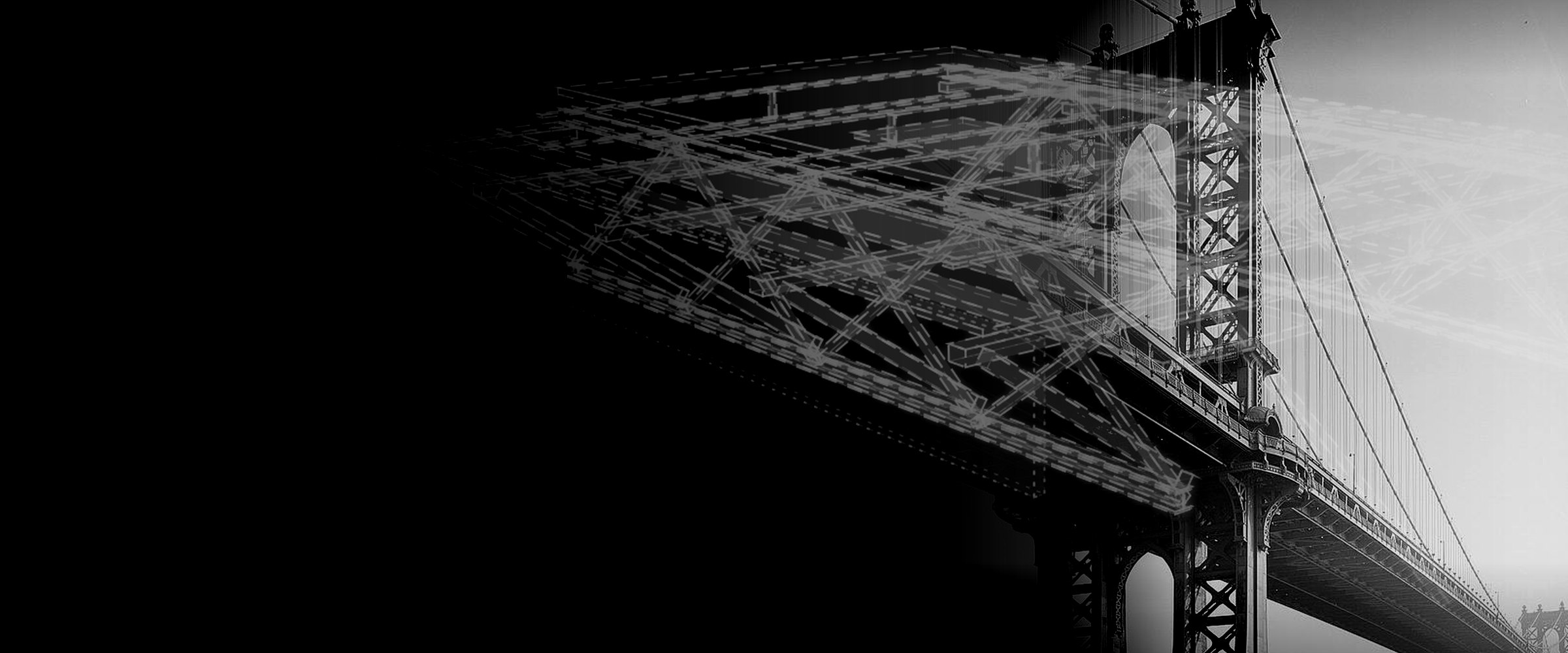
Photograph: Historic American Engineering Record NY-127-7, Jack E. Boucher, National Park Service, via Library of Congress — no known restrictions on images made by the U.S. Government. Overlaid wireframe rendered from this repository's own 3D model, so it is inferred geometry and not a survey. Composited by make_hero.py.
The first two are the MTA's own figures and are the most reliable numbers here. The third is derived from public tax-lot data. The fourth is the finding this programme did not expect to make.
Three different readers want three different things.
Each is a single self-contained HTML file: no build step, no server, no network access, no dependencies, no tracking. Open it here, or download it and double-click. Each applies the same provenance discipline to a different medium.
The MTA measured the noise, in DUMBO, at named addresses, and published the levels. The levels are high. Nothing followed. The measurement exists and the response does not, and the gap between those two facts is where this programme lives.
NYC 311 has a complaint descriptor for ice cream trucks and one for “other animals”. It has none for trains. Neither does SONYC, NYU's 150-million-clip urban sound corpus, whose authors state in print that they built their taxonomy from the NYC noise code — which is where the absence originates.
This is a mechanism rather than a motive, which makes it testable, and it yields the first remedy in the programme that a resident could act on this month: amending a taxonomy is a far smaller ask than solving the noise.
Exposure is people multiplied by events. Optimising on attendance alone pointed to the weekend afternoon. Optimising on train rate alone pointed to the weekday morning. Both were published here and both are withdrawn. Train rate is nearly flat from 07:00 to 19:00 while the number of people underneath changes by a factor of four, so the product peaks between the two: 14:00 on a weekday, 13:00 Saturday, 15:00 Sunday.
A four-cohort model pins total non-resident presence to about ±10%. The split between workers and visitors inside that total swings by more than half again across thousands of parameter sets that fit the data equally well. A departure curve carries no job titles — someone present for eight hours looks identical whether they came to work or came for the day. On a Saturday the model is explicitly degenerate and says so in its own output.
The model was therefore retracted before it was published rather than after — the first time in this programme that has happened in that order. It is also under review in its own right, at issue #28, because a negative result asserted from four points is as vulnerable to over-claiming as a positive one.
The levels have been on the record for two decades. The legal mechanism joining that record to the absence of any remedy is rated 2/5 and written as a question, not a finding — and the document that proposes it names that joint as the first place to attack it, because the finding is elegant and arrived unexpectedly, which is exactly the condition under which this programme has previously over-claimed.
Everything above is a summary. Twelve documents, roughly 130,469 words, every quantitative claim carrying a quoted source and a rating, and every error left standing in the text with the correction beneath it.
Submit a field observation · File a correction — both forms make the provenance fields (where, when, out of what, and what it was for) structurally required, because a count without a denominator cannot be used and a count whose purpose was never stated can be read for the wrong thing.
Silencing the Span: Defining the Manhattan Bridge Rail-Noise Problem in DUMBO for a Design-Build Intervention. Ethical Tech CoLab. Research content released under CC BY 4.0. Not peer-reviewed. No option in any document is recommended for procurement.
This page was generated by build_pages.py from commit 6f6b90d on 2026-08-11. Repository · Open issues